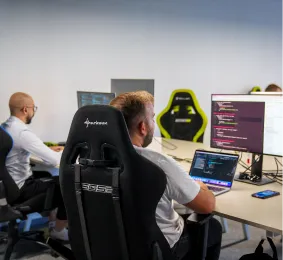
Webflow in 2026
Choosing the right platform for a website is not always as simple as comparing features and prices.
WordPress, Webflow, Shopify, Wix, custom development and other platforms can all be good choices depending on what the website needs to do.
At sunray.media, we work with Webflow regularly, but that does not mean Webflow is the right solution for every project. The important question is what the website needs to achieve, how it will be managed, and how much flexibility the business needs in the future.
Here are the main advantages and limitations we consider when deciding whether Webflow is the right choice.
The Pros of Webflow
1. Almost complete design freedom
One of the biggest advantages of Webflow is the amount of control you have over the design. You are not limited to choosing a template and changing a few colors and fonts. A website can be built around the brand, content and user experience from the beginning.
This is especially useful for companies where the website is an important part of the brand. You can create custom layouts, responsive designs, animations, interactions and components while maintaining control over how everything behaves across different screen sizes. For a developer, this also means that a Figma design can usually be translated into a very close production version instead of having to redesign the concept around the limitations of a template.
2. Flexible CMS
Webflow CMS is another major advantage.
Instead of manually creating every page, you can create structured collections for things such as:
- Blog posts
- Case studies
- Team members
- Services
- Locations
- Products
- Projects
- Resources
Once the structure is created, new content can be added without rebuilding the entire page. This becomes particularly valuable for websites that need to grow over time.
3. Strong control over SEO
Webflow provides control over many important technical and on-page SEO elements, including page titles, meta descriptions, indexing settings, canonical tags, redirects and sitemap functionality.
It also supports adding structured data and other technical SEO configurations.
However, having SEO controls does not automatically mean that a website will rank well. The platform is only one part of SEO. Content quality, technical implementation, site structure, backlinks, performance, search intent and ongoing optimization still matter.
This is why we usually treat Webflow development and SEO as connected parts of the same project rather than completely separate tasks.
4. Less maintenance compared with plugin-heavy platforms
One of the biggest differences between Webflow and platforms such as WordPress is how the website infrastructure is maintained. With a typical WordPress setup, you may have a CMS, theme and multiple plugins that all need to be maintained.
Webflow provides managed hosting and handles much of the underlying infrastructure, including SSL and hosting security. That does not mean Webflow websites require zero maintenance. They still need content updates, SEO work, analytics monitoring, testing and technical improvements.
But there are fewer infrastructure and plugin-related issues to manage.
5. Fast development and iteration
For the right type of project, Webflow allows teams to move quickly from design to production. A developer can build directly around the approved design, create reusable components, connect CMS content and publish changes without having to build an entire backend infrastructure.
This is particularly useful for marketing websites where speed matters and the team needs to continuously make changes.
Webflow also supports staging and production environments, which makes it easier to work on changes before publishing them live.
The Cons of Webflow
Webflow is not perfect, and there are situations where we would recommend something else.
1. It can become expensive
Webflow uses a site-based pricing model, and hosting a website on a custom domain requires a Site plan. Some features, including CMS functionality and advanced SEO capabilities, depend on the selected plan.
For a simple website that rarely changes, this can make Webflow more expensive than some alternatives. The cost becomes easier to justify when the business actually benefits from the platform's flexibility, CMS, design control and managed hosting.
2. It is not designed to replace every type of application
A website and a web application are not the same thing. If you need complex user accounts, advanced dashboards, highly customized databases, complicated business logic or application-level functionality, Webflow may not be the right foundation.
Webflow can be extended with JavaScript, APIs and third-party services, but at some point it makes more sense to use a dedicated application stack. A good Webflow developer should know where that boundary is.
3. Complex functionality often requires custom development
Webflow handles many common website requirements natively, but more advanced functionality may require JavaScript, APIs or external services. For example, we have built custom functionality around scheduling, analytics, forms and third-party integrations where the native Webflow features were not enough.
This is not necessarily a disadvantage.
It simply means that the quality of the final website depends heavily on how the custom functionality is implemented.
Poorly written custom code can make a website harder to maintain, while properly structured code can significantly extend what Webflow can do.
4. E-commerce has limitations. Webflow can be used for e-commerce, but it is not automatically the best choice for every online store.
If a business has a large catalog, complex inventory management, subscriptions, advanced checkout requirements or sophisticated e-commerce workflows, a platform such as Shopify may be more appropriate. For smaller and more design-focused stores, however, Webflow can still be a strong option. The important thing is to evaluate the actual requirements before choosing the platform.
5. Webflow still requires technical knowledge
One common misconception is that because Webflow is visual, anyone can build a professional website with it.
That is not really the case. Understanding HTML, CSS, responsive design, accessibility, SEO, performance, CMS architecture and JavaScript becomes increasingly important as the project becomes more complex.
The difference between a website that simply works and one that is scalable, maintainable and optimized often comes down to how it was built behind the visual interface.
Webflow vs. Traditional Development
The choice is not necessarily between Webflow and "real development."
Webflow itself is a development environment.
The better comparison is usually between:
Webflow + custom development and A completely custom website/application stack.
For a marketing website, corporate website, agency website, portfolio, service business or content-driven website, Webflow can provide a very good balance between design freedom, development speed and maintainability. For highly complex applications, custom software will usually make more sense.
The key is choosing the technology based on the requirements rather than choosing the technology first and trying to force the project into it.
Webflow vs WordPress: the honest comparison
Technical Capabilities
Ensure the agency understands:
CMS architecture
JavaScript integrations
SEO implementation
responsive design systems
SEO Knowledge
Many Webflow developers focus only on design. Agencies that understand technical SEO and content architecture provide more long-term value.
The Future of Web Development Is Visual
The demand for faster digital experiences is pushing companies toward modern development tools.
Webflow sits at the intersection of:
visual development
performance optimization
scalable content management
For organizations that want speed, flexibility, and strong SEO foundations, working with a Webflow development agency is increasingly becoming the preferred approach.
Conclusion
Webflow development agencies enable businesses to launch professional websites faster while maintaining strong SEO and performance standards.
By combining design flexibility, structured content systems, and modern hosting infrastructure, Webflow provides a streamlined alternative to traditional development workflows.
For companies looking to build scalable digital platforms, partnering with experienced Webflow developers can significantly accelerate growth.